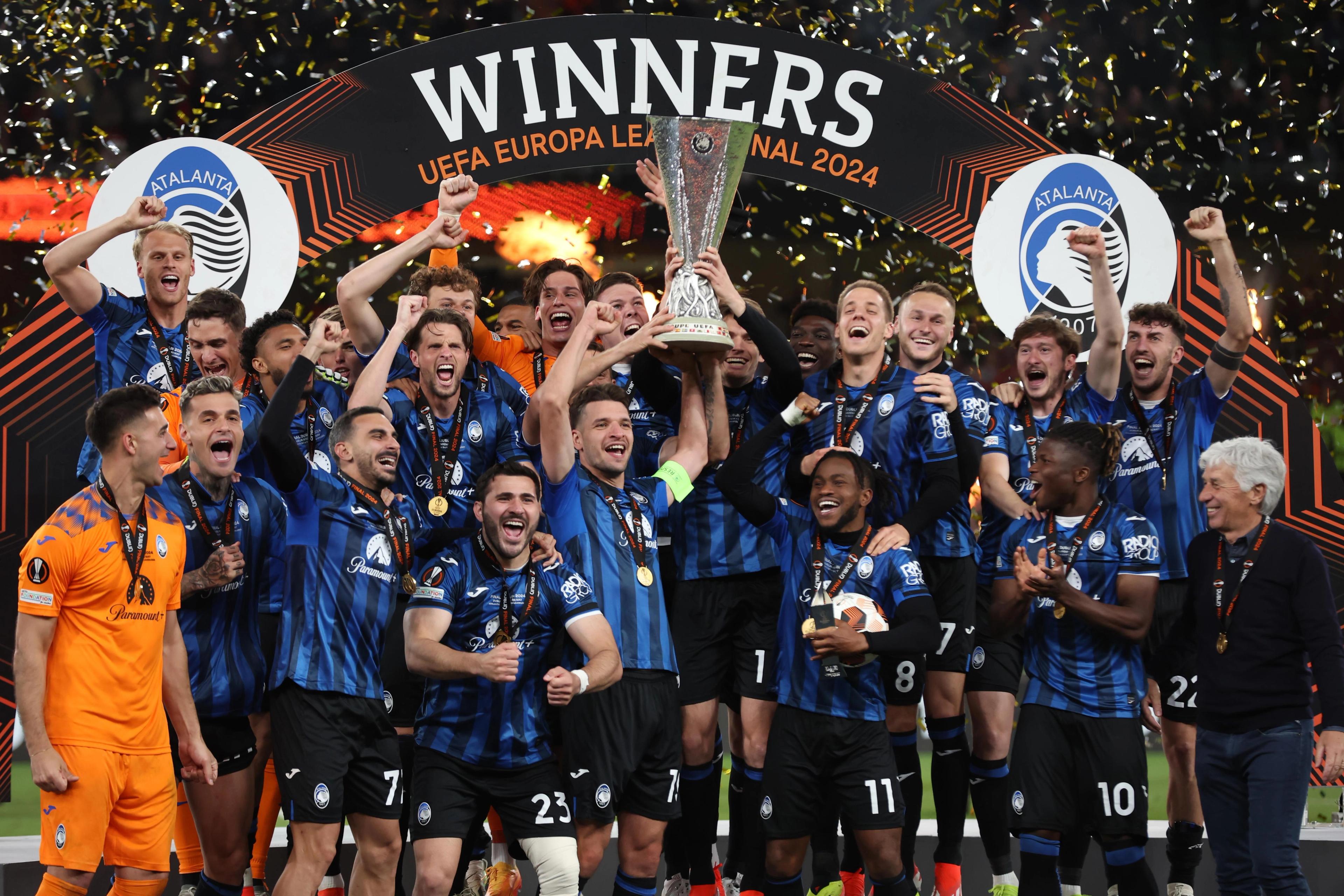
There is a particular kind of football success that arrives so spectacularly that it hides the years of work beneath it.
Atalanta beating Bayer Leverkusen 3–0 in the Europa League final felt like one of those nights. Ademola Lookman scored a hat-trick. Gian Piero Gasperini, the coach many had admired for years without quite knowing where to place in football’s hierarchy, finally lifted a major trophy. Leverkusen arrived in Dublin unbeaten in 51 matches, Bundesliga champions and supposedly too organised, too modern, too complete to be stopped. Atalanta did not merely stop them. They overwhelmed them.
For ninety minutes, the club from Bergamo played like the biggest team in Europe.
That is the version of the story most people remember: a magnificent final, a fearless coach, a player reborn. It is a beautiful story, and all of it is true. But it is also incomplete.
Atalanta’s Europa League was not an accident of one brilliant night. It was the reward for a club that had spent more than a decade learning how to survive without pretending it had the money of Juventus, Inter or Milan. It was the reward for a president who understood that a provincial club could not compete by copying the habits of richer clubs. It was the reward for a recruitment department that kept finding footballers before the market fully agreed on their value. It was the reward for a manager given enough time to build a recognisable idea rather than being sacrificed after one bad month.
Most importantly, it was the reward for financial discipline.
Atalanta did not become a European club by spending like one. They became one by building a structure that made their spending make sense.
The problem Atalanta had to solve
Bergamo is not Milan, Rome or Turin. Atalanta do not possess a worldwide commercial base, an enormous stadium, a glamorous historical brand or the automatic gravitational pull that brings elite players to Italy’s traditional giants. For years, that was simply the reality of the club: good academy, loyal supporters, occasional strong seasons, but a ceiling that seemed obvious.
The danger for clubs in that position is understandable. They look upwards, see the money circulating around the bigger names, and begin to behave as if they are one transfer window away from belonging to that world. They pay wages that their recurring income cannot comfortably support. They buy players to satisfy a manager who may be gone in six months. They treat qualification for Europe as a permanent condition instead of a bonus that must be planned for carefully.
This is how a club begins to spend tomorrow’s money today.
Italian football has seen plenty of versions of that story. The traditional giants may have larger fanbases and greater revenues, but they have also lived with the pressure of immediate success: impatient supporters, expensive squads, managerial churn, transfer-market corrections and owners expected to solve every structural problem with another injection of capital. Money can make mistakes survivable. It can also make mistakes easier to repeat.
Atalanta had less room for error, which eventually became one of their strengths.
Antonio Percassi took control of the club in 2010, after Atalanta had been relegated to Serie B. He did not inherit a project ready to launch into Europe. He inherited a club that needed stability, identity and a credible path back to Serie A. Percassi was not a romantic outsider who happened to fall into football. He was a Bergamo businessman with a long relationship with the city and a practical understanding of what a club of Atalanta’s size could and could not afford to be.
That matters. Good ownership in football is not only about being rich enough to cover losses. It is about making the club’s ambition match its actual resources.
Under Percassi, Atalanta’s objective was never to create a fantasy version of themselves. The aim was more intelligent: establish the club securely in Serie A, invest in the academy and infrastructure, recruit better than the market expected, sell well when necessary, and create a football identity so strong that a departure would not cause the entire project to collapse.
That last part is where many clubs fail. They collect talented people but do not build a system. Atalanta built a system.
The Percassi vision: grow the club, not just the squad
A football club can spend on a player and call it ambition. It can spend on a stadium, its academy, scouting network and operational structure, and call it something more difficult: planning.
Atalanta gradually did the second.
The Percassi family’s leadership—Antonio as president, with Luca Percassi central to the club’s executive direction—gave Atalanta continuity at the top. That continuity made a major difference because it allowed football decisions to be connected rather than restarted every season. The coach, recruitment department, academy and financial department were not all working on separate short-term plans.
The club also bought the Stadio Atleti Azzurri d’Italia from the municipality in 2017 and redeveloped it into what is now the Gewiss Stadium. The stadium should not be treated as the entire explanation for Atalanta’s rise; it is not. But it reveals the logic behind it. A club that owns and improves a stadium creates more control over matchday income, sponsorship opportunities, hospitality and its relationship with supporters. More importantly, it creates an asset.
There is a difference between spending money to look successful and spending money to make success more sustainable.
Atalanta’s stadium project belonged to the second category. It was a long-term bet on Bergamo, on the club’s commercial future and on the idea that European football should not be a temporary guest in the city. It was not designed to buy one famous player. It was designed to make the club stronger when that player had already gone.
That approach extended to the academy. Atalanta’s youth system had long been respected in Italy, but the modern club made it strategically central. Academy footballers could become first-team contributors, valuable saleable assets, or both. The point was not to turn every teenager into a star. The point was to ensure the club always had a pipeline of talent, information and value beneath the first team.
In football, sustainability is often misunderstood as caution. Atalanta showed that it can be a form of aggression. If your club knows exactly where its next value will come from, it can make bold decisions without becoming reckless.
The recruitment department: finding value before it becomes expensive
Atalanta’s rise is impossible to explain without the people who built its recruitment architecture.
Giovanni Sartori, who arrived from Chievo, became one of the key architects of the project. His reputation was built on identifying players whose ability, tactical potential or market value had not yet been fully recognised. Atalanta did not simply recruit “cheap players.” Plenty of clubs buy cheap players. The more difficult skill is identifying players who can become more valuable inside a particular environment.
That is a different kind of scouting.
A player can be talented but wrong for a club. Another can look ordinary in one system and become exceptional in another. Atalanta’s recruitment model increasingly worked from the question: can this footballer grow here? Not only: is he good today?
Sartori’s technical leadership was supported by Gabriele Zamagna, who had worked in scouting before becoming sporting director, and by a wider department that included scouting leadership such as Giuseppe Corti. The names matter because the mythology around football recruitment often makes it sound like one genius spotting a player in a grainy video clip. It is rarely like that.
Good recruitment is a process. Scouts provide context that data cannot fully capture: personality, adaptability, physical development, family situation, tactical education, how a player responds when a match turns against him. Analysts can narrow a market and compare performance profiles. Sporting directors understand contractual timing, agent relationships, wage structures and the possibility of selling a player later without losing control of the deal. Coaches define what the football actually needs.
Atalanta’s advantage was not that they had one brilliant scout. It was that recruitment, coaching and club strategy increasingly spoke the same language.
Franck Kessié, Roberto Gagliardini, Andrea Conti, Mattia Caldara, Dejan Kulusevski, Cristian Romero, Robin Gosens, Rasmus Højlund and many others became examples of the model in different ways. Some arrived young. Some were developed. Some were given a tactical role better suited to their strengths than the role they had previously occupied. Some were sold at moments when their value was high enough to transform Atalanta’s room to manoeuvre.
The club did not always get every decision right. No recruitment department does. There were signings that did not work and expensive risks that did not deliver exactly as hoped. That is another reason their model is more interesting than a fairytale. Atalanta were not perfect. They were simply structured well enough that an imperfect decision did not become a crisis.
That is one of the real tests of football management. A club is not well run because it never makes a bad signing. It is well run when one bad signing cannot destroy the next three years.
Selling was not surrender
For supporters, selling your best players can feel like a confession of inferiority.
Atalanta turned it into a competitive weapon.
The difference lies in whether a club sells because it has failed to plan, or because it has planned for the possibility of selling. If a team loses its best midfielder on the final day of the transfer window and has no replacement, it becomes weaker. If a team understands the market, sets a valuation, keeps alternatives prepared and already knows how the next player fits the coach’s system, the sale can become part of renewal.
Atalanta’s player trading often followed that logic.
Cristian Romero arrived, developed into one of Serie A’s outstanding defenders, and was sold for a substantial fee. Rasmus Højlund’s single season in Bergamo was short, but his sale to Manchester United gave Atalanta enormous financial capacity. Yet the essential point was not the headline number attached to either deal. It was what the club did with the freedom those sales created.
They reinvested. They spread risk. They kept the squad moving. They refused to make the entire club dependent on the presence of one footballer.
This is where the comparison with larger clubs becomes revealing. A giant club can keep an expensive player too long because it fears the optics of selling. It can buy a replacement because the market expects one, not because the system requires one. It can accumulate contracts that gradually reduce its flexibility.
"Atalanta had to preserve flexibility. That constraint made them sharper."
The club could not afford to carry too many players who did not fit the football. It could not keep spending high wages on reputation. It could not build a squad that required Champions League income just to remain functional. That does not mean Atalanta were cheap. It means they were selective.
There is an enormous difference.
They spent money when they believed the player, age profile and tactical function justified it. They used loans, options, free transfers and development pathways. They looked for footballers who could improve, not merely footballers who arrived with a finished reputation. When a player’s market value rose beyond what made sense for Atalanta to retain, the club could sell without panic because selling had never been treated as failure.
It was part of the operating model.
Gasperini was the footballing multiplier
A recruitment model needs a coach who can turn potential into performance. Atalanta found that coach in Gian Piero Gasperini.
When he arrived in 2016, Gasperini was respected but not universally treated as a safe appointment. His career had included strong work at Genoa, a difficult spell at Inter, and the reputation of a coach with demanding ideas. Atalanta did not hire him because he was a celebrity. They hired him because his football could give the club an identity.
That identity became unmistakable.
Gasperini’s Atalanta pressed high, attacked with numbers, used aggressive man-oriented structures and demanded that players understand movement rather than simply occupy positions. Centre-backs could step into midfield. Wing-backs became attackers. Midfielders were expected to arrive in the penalty area. Forwards were asked to defend, combine and run. A player’s value was not fixed by the role written next to his name.
That was perfect for Atalanta’s recruitment strategy.
The club could identify a player who might not be a finished product for a traditional giant, bring him to Bergamo, give him a demanding but coherent tactical environment, and reveal qualities that had been hidden elsewhere. Lookman is a useful example. He had obvious talent before Atalanta, but in Bergamo he found a setting that gave him responsibility, movement and a clearer attacking role. In Dublin, he was not merely a talented player having a good final. He was the visible outcome of a football structure.
Gasperini’s importance cannot be exaggerated. But neither should it be isolated from the rest of the club.
His methods worked because the squad was assembled to make them work. The squad could be assembled that way because the sporting department had continuity. The sporting department could keep thinking long term because ownership did not mistake every difficult moment for proof that the plan had failed.
That is management. Not a slogan. Not an inspirational presentation. The difficult, patient alignment of people making decisions in the same direction.
Europe changed the balance sheet but did not become the crutch
Champions League qualification changes a club. The prize money, broadcasting income, prestige and ability to attract players can accelerate everything. It can also create a trap.
If a club immediately spends all of its Champions League income on permanent wage commitments, then missing Europe the following year becomes a financial emergency. A good season becomes an obligation. The club starts chasing its own previous success with more expensive, more desperate decisions.
Atalanta had to avoid that trap.
Their repeated European qualification gave them more resources, but their strategy was not built on the assumption that Champions League money would arrive forever. The goal was to use European participation to strengthen the club’s base: squad quality, infrastructure, reputation and trading power. That is why they could remain competitive even as the players changed.
Their European rise was gradual but extraordinary. After returning to Serie A, Atalanta reached the Champions League for the first time in 2019. They reached the quarter-finals in their debut campaign, playing their home European matches away from Bergamo while stadium work continued. They returned to the competition repeatedly. They became familiar opponents for clubs who once regarded them as a favourable draw. The important word is repeatedly.
"One Champions League season can be a story. Several become evidence of a model."
By the time Atalanta reached the Europa League final in 2024, they had already earned the right to be there. They had beaten Liverpool at Anfield. They had overcome Marseille. They had spent years proving that their intensity and clarity of purpose travelled beyond Serie A.
Leverkusen were the final opponent. They were also the final proof.
The Europa League was the dividend
When Lookman completed his hat-trick in Dublin, Atalanta’s victory felt emotional because it was emotional. Bergamo had waited generations for a European trophy. The club’s supporters had lived through relegations, near misses and the strange disbelief of watching their team become a regular part of Europe’s biggest conversations.
But the result was also analytical.
Atalanta beat Leverkusen because their press was brave, their movement was rehearsed and their players believed in the game plan. They beat them because Gasperini had been given time to build a team that knew itself. They beat them because recruitment had repeatedly supplied players suited to that identity. They beat them because the club did not spend its entire future trying to imitate clubs with greater wealth.
And they beat them because, for years, the people running Atalanta had made decisions that added up.
That is why the Europa League should not be reduced to a miracle. Miracles are lovely, but they do not teach much. Atalanta’s story teaches something more useful.
A club does not need unlimited money to become ambitious. It needs a hierarchy of decisions. It needs owners who understand the difference between investment and vanity. It needs a sporting director and scouting department empowered to think beyond the next match. It needs a coach whose football gives recruitment a purpose. It needs the patience to sell well, replace intelligently and keep improving even after its best players leave.
Atalanta did not defeat Italy’s giants by becoming richer than them.
They defeated the logic that says only richer clubs can build something lasting.
The Europa League trophy was not the beginning of the story. It was the dividend paid after years of discipline.
Research basis:
Reuters’ report on Atalanta’s 3–0 Europa League final win and the end of Leverkusen’s 51-match unbeaten run, Reuters on Gasperini’s 2016–25 transformation of Atalanta into regular Champions League participants, UEFA’s Atalanta club history, and AS’s report on the club’s acquisition of its stadium.
Debriefing (0)
Add to the File