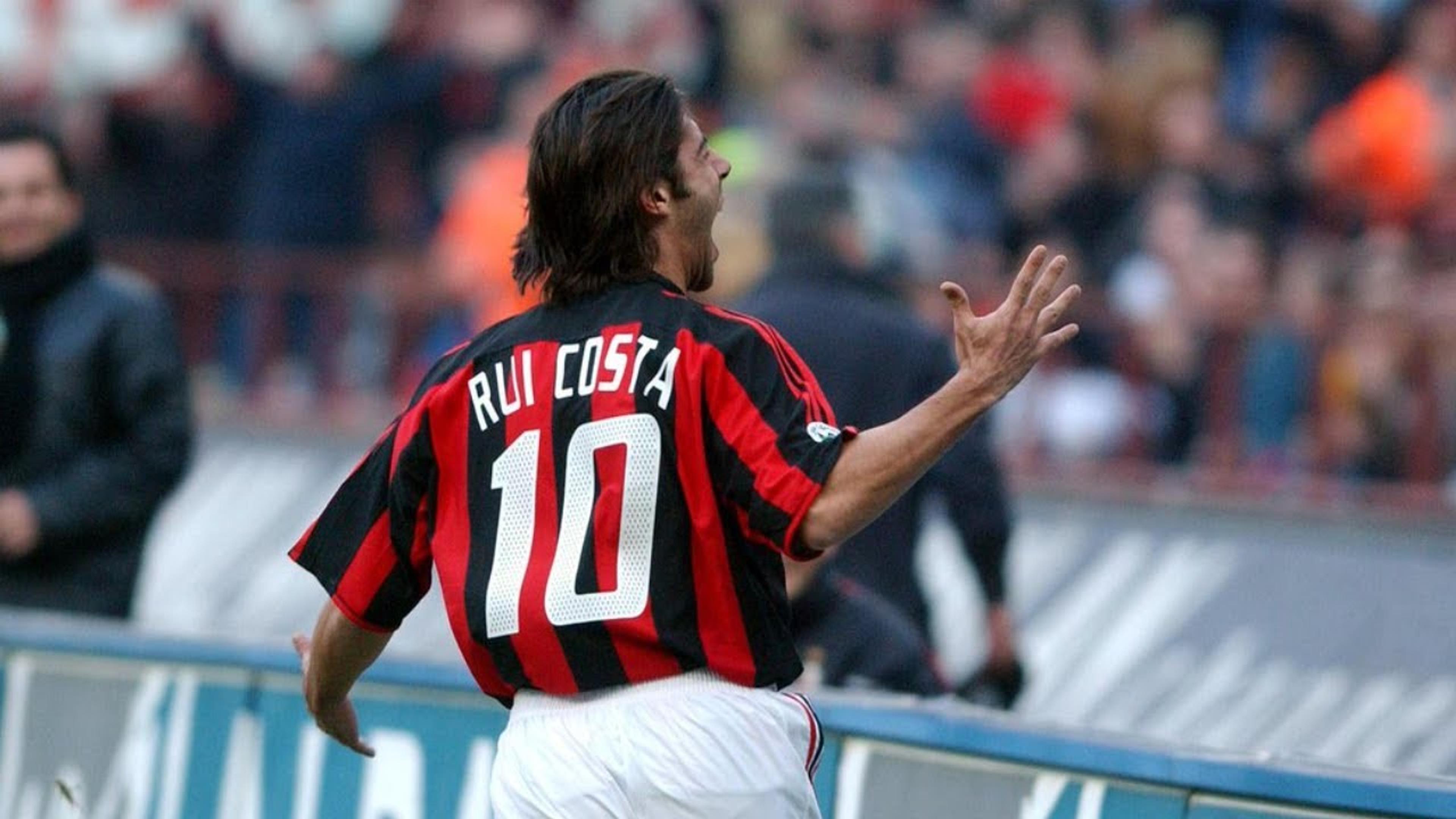
I have always been fond of playmakers. I grew up during an era when they seemed to be everywhere, each offering a different interpretation of how football should be played. There was Rui Costa, carrying the ball with his head raised as if he had already seen the next movement before everyone else. Zinedine Zidane controlled matches with an elegance that made even the most difficult actions appear unhurried. Zvonimir Boban brought intelligence and personality to Milan’s midfield, while Pablo Aimar played with the restless imagination of someone constantly searching for a space only he could see.
That generation was filled with footballers who became cult heroes precisely because they were so distinctive. Juan Román Riquelme could slow an entire match until it followed his rhythm. Djalminha played with an unpredictability that could produce either a moment of genius or complete chaos. Juan Carlos Valerón passed the ball with unusual softness, while Álvaro Recoba could transform a game with his left foot from almost anywhere. Ariel Ortega, Gheorghe Hagi, Robert Prosinečki, Jari Litmanen and Youri Djorkaeff all belonged, in different ways, to the same broad family of players: footballers trusted to provide the imagination around which an attack could be built.
They were not identical, and many did not occupy exactly the same position. Some carried the ball through midfield, some controlled the rhythm, some operated almost as second strikers, and others preferred to release the decisive pass before entering the penalty area themselves. What connected them was the feeling they created whenever they received possession. The ball arriving at their feet did not merely continue an attack; it opened a new set of possibilities.
I loved how those players became the source of their team’s creativity. Their teammates could recover possession, provide width, make runs and stretch the defensive line, but the playmaker was expected to give those movements meaning. He decided whether the attack needed to accelerate or pause. He recognised a run before it had fully developed and sometimes placed the ball into space as an invitation for a teammate to discover it. Watching them taught me that creativity in football was not only about performing a beautiful trick. It was about understanding the match slightly earlier than everyone else.
I particularly loved the Italian name for the role: trequartista. Even the word sounded as beautiful as the football it described. Italian football had names for its specialists, the regista directing the game from deeper areas, the mezzala moving through the inside channels, and the fantasista liberated to invent, but trequartista was the one that captured my imagination. It did not sound like a position assigned on a formation graphic. It sounded like a profession reserved for someone who understood football as an art.
There was a time when you could understand a team simply by finding this player. He would be somewhere between the midfielders and forwards, occupying an uncertain territory where defenders were reluctant to follow and midfielders were afraid to leave behind. While everyone else ran, tackled, marked and maintained the structure of the team, the No. 10 appeared to be doing something different. He was watching, waiting and interpreting.
Today, players still wear No. 10 and teams still field attacking midfielders, yet the classic version of the role has become increasingly difficult to find. The shirt remains prestigious, but the tactical privilege once attached to it has largely disappeared. Modern football did not decide that creativity was no longer valuable. Instead, it changed so profoundly that creativity could no longer remain the responsibility of one protected player standing in one permanent area of the pitch.
"The classic No. 10 did not lose his value; he became tactically unaffordable."
When the team belonged to the playmaker
The classic No. 10 was positioned behind one or two forwards and ahead of the central midfielders. In a 4-3-1-2, he occupied the point of the midfield diamond. In a 4-4-1-1, he connected the midfield with the centre-forward. In other systems, he operated as a second striker who dropped away from the defensive line to receive the ball.
The arrangement gave him access to what remains one of the most valuable areas in football: the space between an opponent’s midfield and defence. Receiving there forced defenders into uncomfortable decisions. If a centre-back stepped forward, a striker could attack the space behind him. If the centre-back remained in position, the playmaker could turn and face goal. If a defensive midfielder followed him too closely, another midfielder could move into the space that had been abandoned.
The team was constructed partly to help its No. 10 reach this territory. Deeper midfielders recovered possession and protected the defence. Full-backs or wide midfielders provided width. Strikers stretched the back line and made runs beyond it. Once those pieces were in place, the playmaker was trusted to interpret the situation rather than follow a predetermined instruction.
This was the environment in which players such as Rui Costa and Riquelme thrived. Their influence was not measured only through assists or goals. They controlled where the attack developed, who received the ball and when the game changed its rhythm. They were not simply the final passer but the central reference point through which the team understood possession.
There was a degree of tactical inequality in this arrangement, but it was accepted. Other players performed more defensive work so the creator could preserve his energy and freedom. The team carried part of his burden because it believed he could carry the burden of invention. When a match became static and ordinary solutions stopped working, the ball returned to him.
The space began to disappear
The No. 10’s traditional territory still exists, but modern teams have become far better at defending it. Defensive units now maintain shorter distances between their forwards, midfielders and defenders. Wingers move inside when possession is lost, midfielders protect central passing lanes, and centre-backs are increasingly prepared to step forward when an opponent receives between the lines.
Instead of asking one player to mark the opposition playmaker, teams attempt to control his space collectively. A defensive midfielder blocks the passing lane into him, another midfielder applies pressure from the side, and a centre-back prepares to engage if he turns. The No. 10 who once found room between separate defensive lines is now surrounded by a compact block moving as one unit.
The speed of the game has also changed the value of time. A playmaker may still receive in the same area as Rui Costa or Riquelme, but he is rarely given the same opportunity to stop, look and decide. He must scan before the ball arrives, control it while under pressure and release it before the surrounding defenders close the space. The difference may only be one or two seconds, but at the highest level those seconds separate freedom from dispossession.
This is why the modern creator cannot simply wait in the traditional pocket. He must move away from it and return at the correct moment. He may drift toward the wing, drop beside the central midfielders, exchange positions with a forward or make a run beyond the striker. Movement is no longer an additional quality for a No. 10; it is often the condition that allows him to receive the ball at all.
The game did not remove the area between midfield and defence, but it made permanent occupation of that area easier to predict and defend. The old No. 10 expected the team to find him there. His modern successor must first help create the conditions that make the pass possible.
Pressing changed the job description
The greatest threat to the classic No. 10 may not have come from what happened when his team possessed the ball. It came from what was expected when his team lost it.
Pressing in modern football is not simply a collection of hardworking players chasing possession. It is a coordinated structure in which every movement affects the next one. The centre-forward may direct the opposition toward one side of the pitch, the winger closes the pass toward the full-back, the midfielder moves forward to confront the receiver, and the defensive line advances to keep the entire team compact.
Within that structure, one player who does not participate can create an escape route for the opposition. If the No. 10 fails to close the defensive midfielder, the press can be bypassed through the centre. If he reacts slowly after losing possession, the other midfielders may have to defend a much larger area. The weakness does not remain isolated to one player because collective pressing depends upon the distances and decisions of the entire team.
This does not mean the traditional playmakers were all lazy, nor does it mean every modern attacking midfielder is an outstanding defender. The significant change concerns expectations. In an earlier era, exceptional creativity could justify exemption from some defensive responsibilities. Today, coaches increasingly expect their creative players to understand pressing triggers, close passing lanes, counter-press immediately after losing the ball and recover into the team’s defensive shape.
The question is therefore no longer only whether a player can unlock the opposition. A coach must also ask whether the structure can survive when that player does not have possession. As pressing became more coordinated and transitions became more dangerous, protecting a specialist creator became a tactical expense that fewer teams were willing to pay.
Mesut Özil and James Rodríguez became symbols of this tension. Both possessed qualities associated with the traditional No. 10, including exceptional awareness, passing and the ability to connect midfield with attack. Yet the conversation around them increasingly focused on intensity, mobility and defensive contribution. At times, the criticism became simplistic and unfair, but it revealed how football’s judgment of the position had changed. What would once have been viewed as a specialist’s natural limitation was increasingly treated as evidence that the role itself no longer fitted the modern game.
The formation lost its central artist
The evolution of formations also weakened the No. 10’s permanent home. The 4-2-3-1 remains common, and television graphics still place one player centrally behind the striker, but the role is rarely as fixed as the diagram suggests. In possession, the player may move alongside the striker, rotate with a winger or drop into midfield. Without the ball, he may become part of the front line or retreat into a compact midfield block.
The wider adoption of the 4-3-3 accelerated this transformation. Rather than using one specialist behind the forwards, many teams now field a defensive midfielder with two more advanced central midfielders. Those No. 8s can move into the half-spaces, support the press, help circulate possession and still arrive near the penalty area to create chances.
At the same time, many of the game’s most creative players moved toward the wings. Starting outside gave them more room to receive before cutting into central areas. Lionel Messi became devastating from the right and later as a false nine, entering the No. 10’s territory without being confined to it. Creative wingers could isolate full-backs, combine with overlapping teammates and move inside onto their stronger foot.
The rise of the false nine created another alternative. Instead of positioning a playmaker behind a striker, a team could use a forward who dropped into midfield and performed part of the No. 10’s work. This movement forced centre-backs to decide whether to follow, while wingers attacked the spaces created behind them. The creative centre of the team no longer had to begin in midfield.
None of these developments eliminated the need for a player between the lines. They removed the assumption that one person should live there permanently. The role survived, but its responsibilities migrated into several other positions.
Creativity became a collective responsibility
Perhaps the most important change is that modern football distributes creativity across the team. The classical approach placed a large share of invention in the hands of one playmaker. Contemporary positional structures attempt to create advantages through coordinated spacing, rotations and overloads involving several players.
A full-back may move inside and become an additional midfielder. A winger may hold the touchline to stretch the defence while an advanced No. 8 occupies the half-space. A centre-back may step forward with the ball and break the opponent’s first line of pressure. A false nine may withdraw from the penalty area, while another player attacks the space he leaves behind.
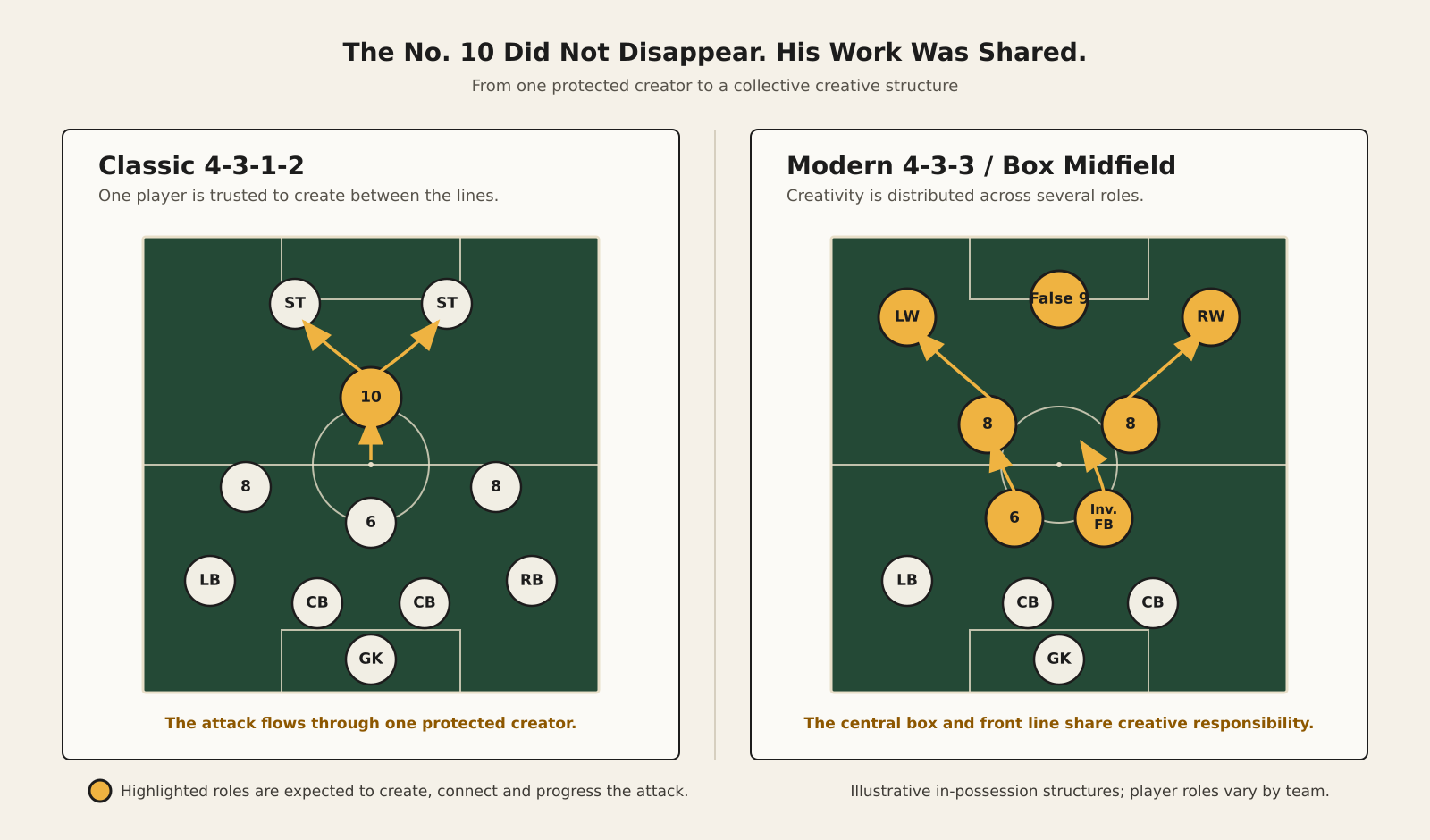
The purpose of these movements is not to eliminate individual expression. It is to produce situations in which creativity can emerge from different points. If the opposition closes the central midfielder, the winger may become free. If it protects the wing, space may appear inside. The system attempts to prevent the attack from becoming dependent upon one player or one route toward goal.
Kevin De Bruyne represents this redistribution clearly. He performs many actions once associated with a No. 10, but much of his most dangerous work begins in the right half-space. From there, he can cross early, combine with the winger, attack the penalty area or play the ball across the defensive line. His creativity is inseparable from his running, timing and understanding of the wider structure.
Antoine Griezmann offers another interpretation. He can operate behind a striker, but he also drops into midfield, moves across the front line and contributes enormous defensive effort. Bernardo Silva and David Silva demonstrated how technically gifted creators could survive within aggressive pressing and possession systems by combining imagination with constant movement.
The playmaker did not disappear. He multiplied.
Ødegaard, Wirtz and the new No. 10
Martin Ødegaard and Florian Wirtz are often described as modern No. 10s, and understandably so. Both possess the vision, close control and passing ability associated with the position. However, their responsibilities reveal how far the role has travelled from the era of the protected trequartista.
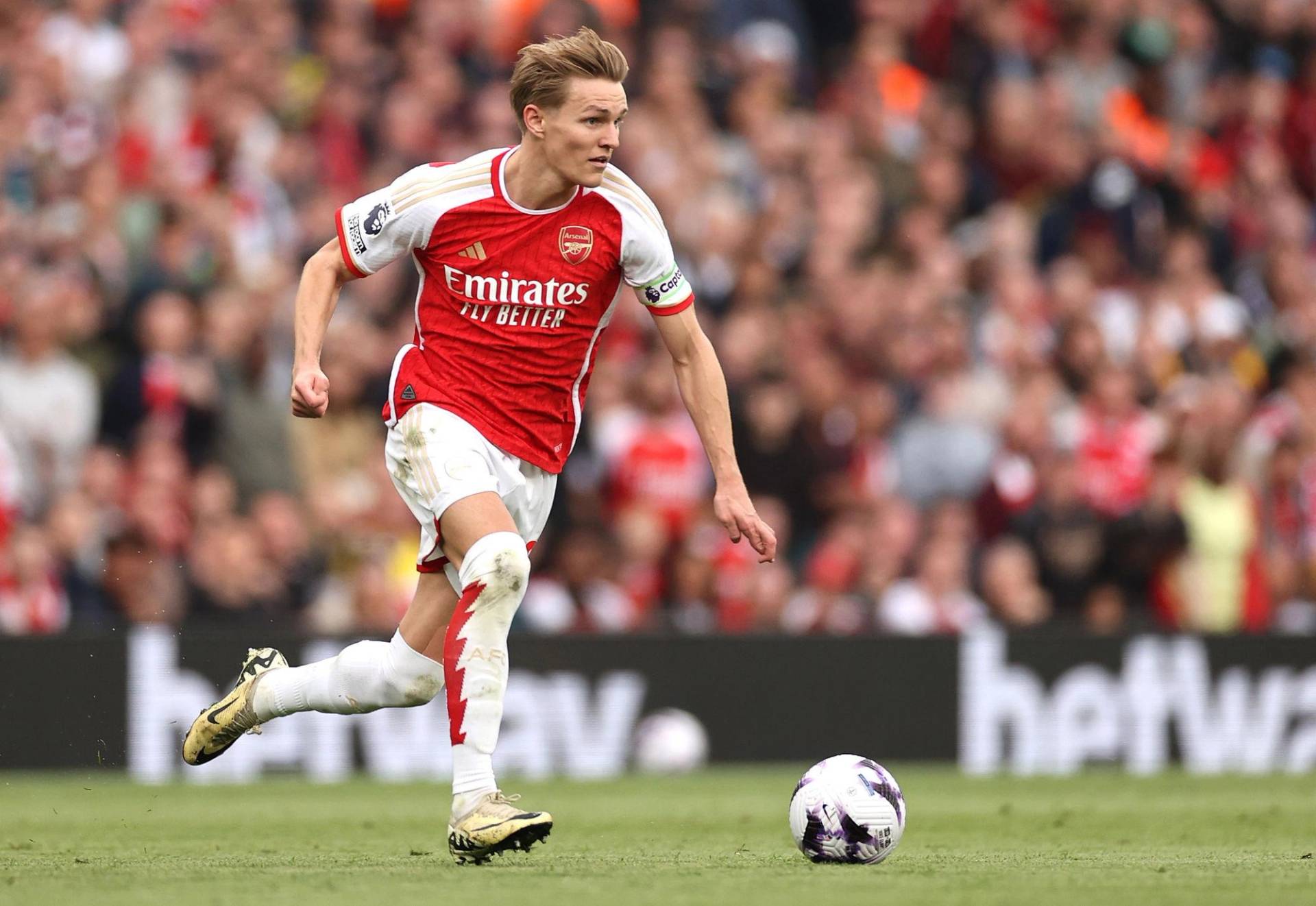
Ødegaard frequently operates from the right half-space rather than remaining directly behind the striker. He combines with the winger and full-back, dictates the direction of attacks and looks for passes into the penalty area. Without possession, he helps lead Arsenal’s press, curves his runs to restrict passing options and works within the team’s collective structure. His creativity is not separated from his tactical labour; the two are part of the same role.
Wirtz is similarly difficult to define through one position. He can receive between the lines like a traditional No. 10, drift wide, carry the ball through pressure, attack the penalty area or combine as part of a fluid front line. His value comes not only from what he does after receiving the ball but also from his ability to find and create space through movement.
They carry the imagination of Rui Costa, Zidane, Aimar and Riquelme, but football asks more of them. They must become playmaker, runner, presser and attacker, sometimes within the same passage of play. They are not inferior versions of the old No. 10, nor are they direct replacements. They are what the position became after football changed the conditions of its survival.
Rui Costa represented an era when the team was built to supply its playmaker. Ødegaard represents an era in which the playmaker must also help operate the entire system.
What did football lose?
Tactical evolution is not automatically the same thing as artistic progress. Modern creators may be more complete, mobile and useful across different phases of the game, but something was lost when football stopped giving one player permission to exist outside its normal rhythm.
The classic No. 10 offered contrast. In a sport becoming increasingly fast, he could slow the match down. Within a structure, he could improvise. While others followed rehearsed movements, he was trusted to recognise when the planned solution was no longer enough.
Riquelme did not appear hurried simply because everyone around him moved quickly. His calmness forced the match to obey his tempo. Baggio could occupy the uncertain border between midfield and attack without being reduced to one tactical category. Totti played with the authority of someone who did not merely participate in Roma’s attacking system but represented its imagination.
Part of my nostalgia comes from that visibility. It was easier to recognise the player responsible for creativity because the team’s technical and emotional personality was often concentrated in one figure. Supporters knew where to look when possession became difficult and the match required an idea. The ball would find the No. 10, and for a moment the structure of the team would surrender control to an individual imagination.
Modern football can still be beautiful, but its beauty is often collective and engineered. The decisive space may be created by three coordinated movements before the final passer touches the ball. The most important creative action may come from an advancing centre-back, an inverted full-back or a winger moving inside as part of a rehearsed rotation.
There is intelligence and beauty in that football too. Yet it feels different from watching a team hand responsibility to one player and ask him to solve the problem.
The No. 10 is not dead
It is tempting to describe this history as the death of the No. 10, but football rarely kills a role completely. It absorbs the role, divides its responsibilities and returns them in a different form.
Teams still need players who can receive between the lines, manipulate defenders and recognise the pass that others cannot see. Against a deep defensive block, those qualities may be more valuable than ever. The game has not outgrown imagination. It has simply attached new conditions to it.
The modern No. 10 must be able to leave the centre and return at the correct moment. He must contribute when his team loses possession and understand how his movement affects the structure around him. He may begin as a No. 8, winger, false nine or second striker, but the old creative instinct remains visible whenever he receives the ball in a crowded area and discovers a possibility that did not seem to exist.
Perhaps the better question is not what happened to the classic No. 10, but what happened to the football that once allowed him to stand apart. The spaces became smaller, pressing became collective, formations changed and creativity became distributed across the team. The protected artist gradually became incompatible with the machinery surrounding him.
I still miss the old trequartista. I miss the anticipation that came when Rui Costa received the ball behind the midfield, or when Zidane turned away from an opponent and suddenly faced the entire pitch. I miss football teams whose identity could be traced to one player entrusted with their imagination.
However, when Ødegaard creates from the right half-space, when Wirtz escapes pressure and carries the ball toward goal, or when a modern creator makes a complicated match appear simple, something familiar remains. The role no longer lives permanently behind the striker, and the player performing it can no longer wait outside the collective system. Nevertheless, the fundamental desire has survived: every team still searches for someone capable of seeing the game before everyone else does.
The classic No. 10 may no longer exist in the form I grew up loving, but his imagination was never removed from football. It was scattered across the pitch, placed inside new positions and given new responsibilities. Modern football did not destroy its most romantic role; it taught the dreamer how to run.
Debriefing (0)
Add to the File